Through tubes, ramps and everyday materials, children can explore movement, gravity, angles, speed and problem-solving while directing their own learning through play.
Playgroup is a wonderful place for children to enjoy activities that families may not have the opportunity to do regularly at home. It gives children more opportunities to explore STEM activities and schemas alongside other children. In a playgroup environment, they can observe, share ideas, experiment and solve problems together through play.
Find a local Playgroup WA playgroup and discover more opportunities for hands-on learning, connection and fun – Find a Playgroup Near You
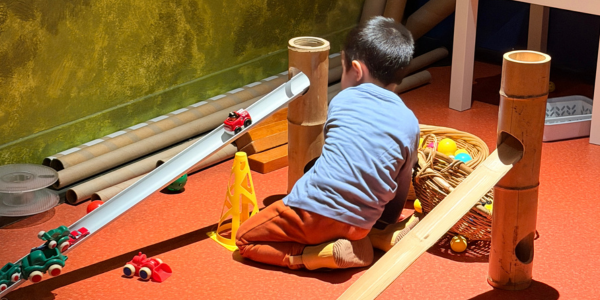
Help your toddler satisfy their urge to post and roll items through tubes and down ramps.
While you create freeform rolling mazes together, you can marvel at how your toddler’s curiosity drives discovery and problem-solving while you delight in your observations.
Explore and support your little one to learn more about physics, engineering and maths as they investigate concepts such as:
Using everyday items to propose and predict trajectories, children will show you just how capable they are of directing their own learning.
Enjoy exploring play schemas alongside your child and remember just how much fun it is to play together.
Schemas are mental models that children develop to help them understand how things work.
Schema play, sometimes described as following urges, is how children learn to make sense of the world. It is especially apparent during toddler play.
When children repeat actions, they are testing whether their schema, or understanding, matches reality. When they are satisfied that their understanding matches reality, they move on to another schema. When their schema and reality do not match, the testing continues.
Two schemas explored through Tube-a-geddon are the posting schema and the trajectory schema.
The posting schema is the urge to release an object into a container.
Along with developing hand-eye coordination and fine motor skills, posting helps children explore:
The trajectory schema describes the urge to throw, drop, run, move, watch movement or interact with anything that is moving.
This can include dropping food from a highchair, moving objects, pouring water or watching something roll down a ramp.
Trajectory is one of the most common schemas because there are so many ways it can be explored. It also requires support to explore safely, as throwing items that are not normally thrown can be especially popular!
Trajectory play helps children explore their understanding of:
STEM stands for:
Through STEM experiences, children develop intellectual dispositions including reasoning, predicting, hypothesising and analysing. These are all important life skills.
Heuristic learning describes how children learn through hands-on experiences.
Children drive their own learning by:
Experimenting with open-ended resources encourages creative thinking and invites imaginative play.
Toddlers use their senses and physical bodies to climb, run, jump and investigate. Their STEM learning needs to be hands-on.
Toddlers may enjoy:
To foster children’s problem-solving and creative thinking, adults can act as a kind of stage manager, supporting their play from behind the scenes.
Play alongside your child, follow their lead and use open-ended questions to prompt and extend their thinking. This can take practice, but the more you do it, the easier it becomes.
Although three-year-olds, and younger children, often like to ask “why?”, they can find it difficult to answer “why” questions themselves. Try asking “what” questions instead.
You can also use descriptive and mathematical language while playing together:
| Movement and position | Size and measurement | Shape and direction |
|
|
|
Use an old tissue box to hold posting items. Children focus on their senses because they cannot easily see the item. They can feel it and think about what it could be before seeing the object.
Post items such as pom-poms or pasta into an empty juice bottle. You can cut the bottom out to make it easier to retrieve the items, if desired.
Tape a cardboard tube to a table leg and post pom-poms or other small items through the tube.
Use a cardboard box, such as a shoebox, tissue box or gift box.
Cut a rectangular hole in the top and a square hole in one side that is big enough to look through. Children can post items and then check that they are inside the box by looking through the side.
Items could include:
Always choose items that are safe and suitable for your child’s age and stage of development.
Make a ramp from a cardboard box by detaching one side and folding it inwards to create a wedge shape.
Test different household objects to find out which ones roll.
You could also take a nature walk and discuss whether objects such as gumnuts might roll along a path, bench or branch. Collect some to test on your cardboard ramp later.
Cardboard ramps are also great for toy car races.
Choose activities and materials that are safe and appropriate for your child’s age, abilities and level of supervision.
Using Schemas to Observe and Plan More Engaging Activities
Understanding play urges (play urges are another way of describing schemas): I Just Can’t Help Myself: Understanding the Links Between Urges and Play
Playgroup WA has been supporting, servicing and establishing playgroups throughout Western Australia since 1972.
